These are documented capabilities, not Stackbroker integrations or partnerships. We are building the transaction layer between personal agents and permissioned supply.
04 / The productConsumer transaction network
One request. A market of better options.
An illustrative salon request
“Haircut next week, after 4pm; flexible Tue–Thu; all-in under $45.”
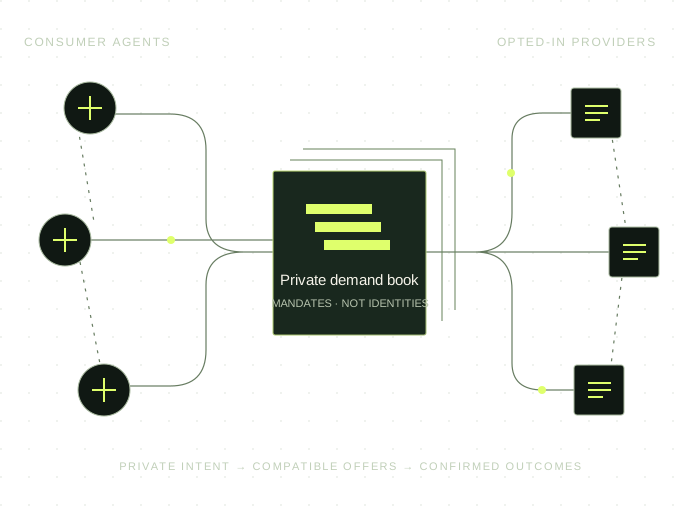
A private mandate carries timing, preferences and spending authority. The owner authorizes the offered terms before a provider confirms.
A haircut after 4pm, Tuesday to Thursday next week. The $45 ceiling includes the proposed fee.
Example service price$40.00
Success fee, if confirmed$0.50
Illustrative all-in total$40.50
No booking, payment or personal data is created by this illustration.
05 / The networkNetwork-effect hypothesis
Flexibility becomes leverage.
Begin with a better result for one consumer. Pool compatible demand only when real local density makes an offer worthwhile.
01
Compatible intent
Real, unique consumers. Authorized needs, not speculative agent traffic.
02
Worthwhile offers
Providers choose terms that make available capacity useful.
03
Better outcomes
A better price, earlier access or a more suitable appointment.
04
Repeat agent use
Confirmed results earn the next mandate—and potentially more demand.
Local liquidity. Not global agent count.
Network effects are a hypothesis. Consumers and providers can use multiple services. Defensibility must come from repeat outcomes in a compatible local market.
Phase 1: single-consumer utility. Phase 2: pooled offers. Providers do not receive exact local demand counts or consumers’ private budgets.
06 / The beachheadConsumer transaction network
Win the next available appointment.
Start where access is real
One connector.
Salons, barbers & auto detailing.
Technical pilot candidates with discrete services, flexible timing and expiring capacity. Choose one permitted connector and opted-in providers in one local pocket.
No geography selected. Provider access and usable scheduling permissions determine the first market.
EARLY
Dental cancellation discovery
For existing patients and practice-approved slots. Separate clinical/privacy review and scheduler boundaries; discovery does not confer booking authority.
LATER
Recurring household negotiation
Extend consumer mandates to repeat purchases after fulfillment and payment economics work.
LAST
Restaurants
Enter only after proving distribution and repeat transaction quality in simpler categories.
07 / DistributionProposed distribution test
Build into agents. Borrow existing demand.
Launch through independent builders and provider-owned waitlists. Meet the consumer at an existing moment of intent.
2
independent agent-builder integrations
+
3
opted-in providers with existing demand
→
One local pocket.
Proposed pilot configuration. No partners committed.
Make trying it easy.
Free bounded tools and keys. Integrate a useful action without a consumer subscription or dashboard acquisition funnel.
Return evidence.
A successful outcome returns machine-readable proof to the agent and a clear receipt to its owner.
Earn actual use.
Provider-owned waitlists create consumer pull. Tool registries enable discovery; they do not create adoption.
08 / Business modelInitial fee hypothesis
A small fee. Only when it works.
$0.50
Proposed consumer-authorized fee per provider-confirmed booking.
Free bounded discovery, orders and failed matches. Providers free. No subscriptions, paid rankings or data sales.
01
Charge for a confirmed outcome.
Reverse the fee for provider or system failure. Merchant cancellation terms are separately disclosed.
02
Prove the payment economics.
Card/MPP and x402 eligibility and cost remain pending. No forced wallet. Sponsored fees may help launch; unsponsored repeat use must prove willingness to pay.
Ordinary-card sensitivity illustration
$0.50 − ($0.50 × 2.9% + $0.30) = $0.1855
Before operating costs. Assumed ordinary-card pricing—not verified machine-payment pricing.
Defensibility to earn: authorized supply integrations, distribution, repeat outcome quality, private demand liquidity and reliable reconciliation. MCP alone is not a moat.
Market roles, not an exhaustive feature comparison. No claim that competitors lack AI or that named companies are partners.
11 / The teamConsumer transaction network
Founder-led. Agent-accelerated.
Founder
Doug Butdorf
Build quickly. Keep human accountability.
Current development is supported by AI agents. They are tools for faster execution, with people accountable for customer outcomes.
01
Founding engineer
Proposed hire to own the transaction core, reliability and production discipline.
02
Integrations / full-stack engineer
Proposed hire to connect permissioned supply and deliver the end-to-end consumer outcome.
03
Focused specialist support
Fractional design, security, legal and operations expertise as the pilot demands it.
The next hires pair transaction engineering with hands-on provider activation.
12 / The askProposed financing plan
Build the consumer side of the agent economy.
$2 million.
Proposed pre-seed / 18 months
Public discussion draft. Financing amount and terms remain to be determined.
The evidence to earn: repeat paid use, positive variable contribution and a reproducible local rollout.
 stackbroker